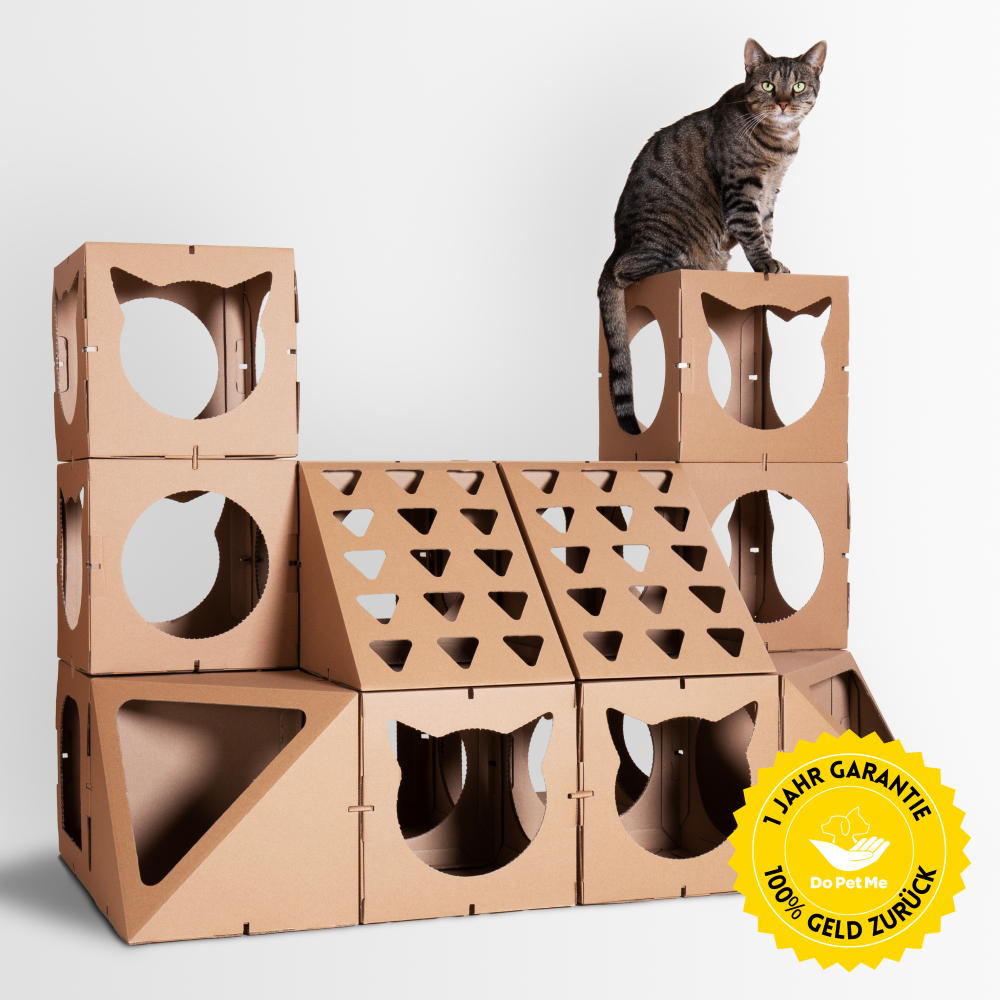


A cat house / scratching post is not a piece of furniture.
It is a part of your cat's territory – a place for security, warmth, play, sleep, and control.
That's why many cats don't use purchased houses at all: they are pretty for humans, but built incorrectly for cats.
In this guide, I'll show you the 5 criteria that really matter – based on cat behavior, instincts, and practical experience from thousands of customer feedbacks.
1. The size must match your cat's proportions, not just your home
Cats need snug, not spacious, room.
A cat house / scratching post should be:
-
snug enough to offer protection
-
but large enough for the cat to turn around
-
have a clear opening (front or side)
Ideal dimensions:
approx. 35–45 cm width, 25–40 cm height
Why this is so important:
Cats feel safer in small spaces, sleeping more deeply and relaxed there.
2. Material determines use or disregard
Typical mistakes:
-
Plastic → smells artificial
-
cheap wood → too hard, too noisy
-
fabric houses → unstable, absorb odors
What works?
→ Cardboard (Yes, really)
→ Wood (if untreated)
→ Felt (if stable)
From a cat's perspective, cardboard is:
-
warm
-
safe
-
natural
-
odorless
-
quiet
-
flexible
That's why cats love cardboard houses – much more than expensive designer items.
3. The opening must be cat-logical; this is often the misconception
Houses open at the front are pretty for humans, but uninteresting for cats.
A good opening has:
-
only ONE main entrance
-
a slight elevation or border
-
visual protection
-
a feeling of a crawl space
Why?
Because cats need "baby security mode" – control without visibility.
4. Stability determines whether the cat stays or moves on
Many cat houses appear unstable, tipping or cracking when jumped on.
This is enough to permanently deter a cat.
Checklist:
-
can one jump on top?
-
are there cracking noises?
-
are the walls stable?
-
is it non-slip?
A good house withstands:
-
climbing
-
jumping
-
paws going in and out
-
turning around
-
scratching
-
weight up to 8–10 kg
5. The house must match your cat's natural behavior
Most cats only use a house if it corresponds to their instincts:
-
den instinct
-
need for protection
-
territorial behavior
-
scratching instinct
-
play drive
-
urge to observe
A good cat house / scratching post fulfills at least three of these simultaneously.
Examples of how to choose the perfect house (without jargon)
For shy cats:
→ small entrance
→ enclosed interior
→ soft padding
For active cats:
→ stable construction
→ opportunity to jump up
→ openings for paw play
For indoor cats:
→ multiple levels
→ tunnels, openings, small challenges
For large cats (Maine Coon etc.):
→ wider entrances
→ higher interior
→ reinforced walls
If you don't feel like comparing all this yourself…
Many owners write to us that they had previously bought several houses that their cat ignored. Only when they understood the 5 criteria did it become clear why.
We have designed our cardboard houses based on exactly these principles:
-
snug, safe interior
-
stable walls
-
openings for play
-
space-saving, light, natural
-
living room friendly design
If you're looking for inspiration, you can find some examples here →
To the cat house overview: Cardboard Cat Houses